


Master Academic Essay Writing Using English for Nurses: The Ultimate Gibbs Reflective Cycle Guide

Table of Contents
The Importance of English for Nurses in UK Reflective Writing
UK nursing programmes are deeply invested in reflective practice, routinely requiring students to format their academic essays around the Gibbs Reflective Cycle. For international students and professionals with English as a second language, transitioning from basic workplace communication to deep academic critique is an incredibly daunting hurdle. At English for Nurses, we understand that navigating this structured cycle demands a sophisticated vocabulary that standard textbooks rarely teach.
The primary difficulty arises when international nursing students try to articulate self-critique and psychological responses within a rigorous academic framework. Without targeted instruction, reflections often read like a simple list of tasks completed rather than a deep, analytical exploration of a clinical incident. Developing specialised linguistic tools helps bridge the gap between classroom knowledge and clinical evaluation, ensuring your writing meets the strict criteria expected by UK academic markers.
Mastering this style of composition is not merely a box-ticking exercise to secure university passing marks; it is a fundamental professional standard required throughout your entire medical career. To contextualise this requirement, the official Nursing and Midwifery Council written reflective accounts guidelines explicitly demand clear, structured self-evaluation to maintain professional registration and revalidation. By refining your prose today, you prepare yourself for a lifetime of safe, competent, and deeply reflective clinical practice in the UK healthcare system.
How English for Nurses Decodes the Gibbs Reflective Cycle Phrase Bank
Unlocking the full potential of your academic essay requires a structured approach to each of the six distinct stages within the Gibbs cycle. In the initial description, feelings, and evaluation phases, many students fall into the trap of using repetitive or simplistic language to outline clinical events. Our specialised online courses provide explicit phrase banks that empower you to express subtle emotional states and initial evaluations with complete professional confidence, integrating essential concepts of English for Nurses.
As you advance into the analysis, conclusion, and action plan stages, your vocabulary must shift towards high-level critical thinking and objective reasoning. Using complex sentence structures and transitional verbs allows you to smoothly connect your clinical choices to established healthcare theories and guidelines. This ensures your academic writing clearly demonstrates accountability and forward-looking professional development rather than passive observation.
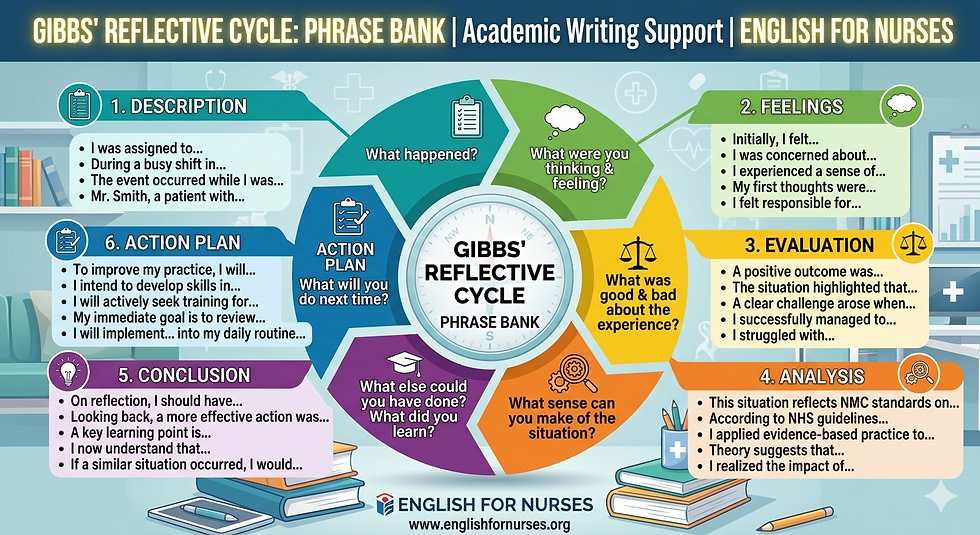
To ensure these critical linguistic patterns are always within arm's reach during busy hospital shifts or late-night study sessions, having portable physical references is invaluable. Students can significantly accelerate their learning by using specialised pocket book guides to look up clinical terminology and essay structures instantly. According to the comprehensive Royal College of Nursing guide to reflection, structured reflective frameworks are vital for delivering safe patient care, making these accessible reference materials absolutely essential tools for success.
Moving Beyond Description: Academic English for Nurses Success
The most frequent feedback international student nurses receive is that their writing is overly descriptive rather than deeply analytical. In the UK higher education system, academic markers heavily penalise essays that simply recount a chronological story of what occurred on the ward. By learning targeted academic vocabulary through specialised English for Nurses programmes, you learn how to condense your descriptions and expand your clinical rationale.
Expressing personal feelings or acknowledging mistakes in a foreign language can often make students feel vulnerable or self-conscious. The challenge lies in discussing your emotional responses to a critical incident while maintaining a completely objective, academic tone throughout. Learning how to deploy formal vocabulary enables you to frame your personal experiences through the lens of professional accountability and evidence-based practice.

To overcome these academic obstacles rapidly, students need access to immersive educational solutions that target the intersection of linguistics and healthcare. Engaging with interactive in person courses provides real-time feedback from expert tutors who understand the exact hurdles faced by ESL healthcare workers. Furthermore, incorporating supplementary audio materials like CD language guides into your study routine helps internalise correct pronunciation and natural sentence flow, ensuring you achieve top marks in your assignments.
Frequently Asked Questions About English for Nurses
How does English for Nurses assist international students with reflective essay writing?
We provide tailored vocabulary banks, sentence structures, and professional guidance specifically mapped out for frameworks like the Gibbs Reflective Cycle. Our targeted training moves your academic writing away from basic description and elevates it to the level of deep, critical analysis required by UK universities.
Are these courses effective for improving communication during clinical placements as well?
Yes, because the professional vocabulary used in academic essays directly mirrors the language required for structured handovers and clinical documentation on the ward. Developing these communication skills simultaneously builds your assignment-writing capabilities and your clinical confidence in real-world healthcare environments.
Where can I find additional resources to keep my medical language skills sharp?
To help our community thrive, we encourage all healthcare professionals to stay up to date with the latest news and events via our dedicated educational platforms. We regularly publish fresh insights, academic updates, and clinical vocabulary tips to ensure your communication remains safe, accurate, and completely effective.
Key Takeaway: Final Instructions From English for Nurses
Navigating the academic and clinical demands of the UK healthcare system requires a unique blend of clinical competence and advanced communication skills. Successfully applying the Gibbs Reflective Cycle to your assignments is a major milestone that proves you can think critically as a registered professional. Utilising the specialised resources offered by English for Nurses ensures that language barriers never stand in the way of your academic and professional achievements.
Investing time into mastering your reflective writing skills transforms how you approach clinical practice, patient safety, and future professional revalidation. By shifting your vocabulary from simple descriptions to high-level analysis, you demonstrate the exact attributes expected of a modern UK nurse. The right linguistic tools will protect your grades, build your workplace confidence, and fast-track your career progression within the NHS.
If you are ready to eliminate assignment anxiety and unlock your full potential, we invite you to take the next step today. We strongly encourage you to contact the company to discuss
our bespoke educational packages, courses, and learning resources tailored to your goals.
Our expert team is fully dedicated to supporting your journey toward outstanding academic and clinical communication success.


Comments